Asphalt Crack Repair & Perimeter Sealing
Stop small cracks from becoming big problems. Preserve the strength and appearance of your pavement.

Stop small cracks from becoming big problems. Preserve the strength and appearance of your pavement.
Asphalt crackfilling is the process of applying a flexible, rubberized sealant directly into open fractures to protect the pavement's underlying foundation. In Southern Utah, extreme day-to-night heat variations drive intense thermal expansion and contraction, causing asphalt cracks to open and close constantly. Standard rigid fillers quickly fail under these conditions, making high-performance elastic crack sealers essential to stretch and flex with the moving pavement. Without a resilient seal, cracks rapidly fill with dirt, sand, and water. Because dirt and debris are non-compressible, they lock inside the crack during thermal shifts and force the surrounding asphalt to fracture further under stress. Simultaneously, monsoon rains wash through open gaps directly into the subbase, softening the supporting soil and leading to severe alligator-style cracking and widespread potholes. Hot-applied rubberized crackfill creates a durable, watertight bond that blocks non-compressible debris and floodwaters, extending pavement life prior to routine sealcoating.
Standard hot-applied elastic crack fill is designed for linear, isolated cracks that measure between 1/4 inch and 1.5 inches in width, provided the surrounding asphalt is structurally sound. However, once cracks expand beyond 1.5 inches wide, develop severe edge cupping, or turn into depressed, wide trenches, standard fluid crack sealer slumps, sinks, and tears away under vehicle weight. In these wide or cupped areas, mastic sealers are strongly recommended. Mastic is a heavy-duty, hot-applied repair compound made from a thick mixture of flexible polymer-modified asphalt binder blended with solid aggregate stone fillers. Because mastic includes aggregate, it acts as a bridge between crack filling and full asphalt patching—filling deep, wide gaps up to several inches across with a durable, load-bearing surface that levels out depressions, resists sagging, and withstands heavy traffic far better than standard liquid crack fill.
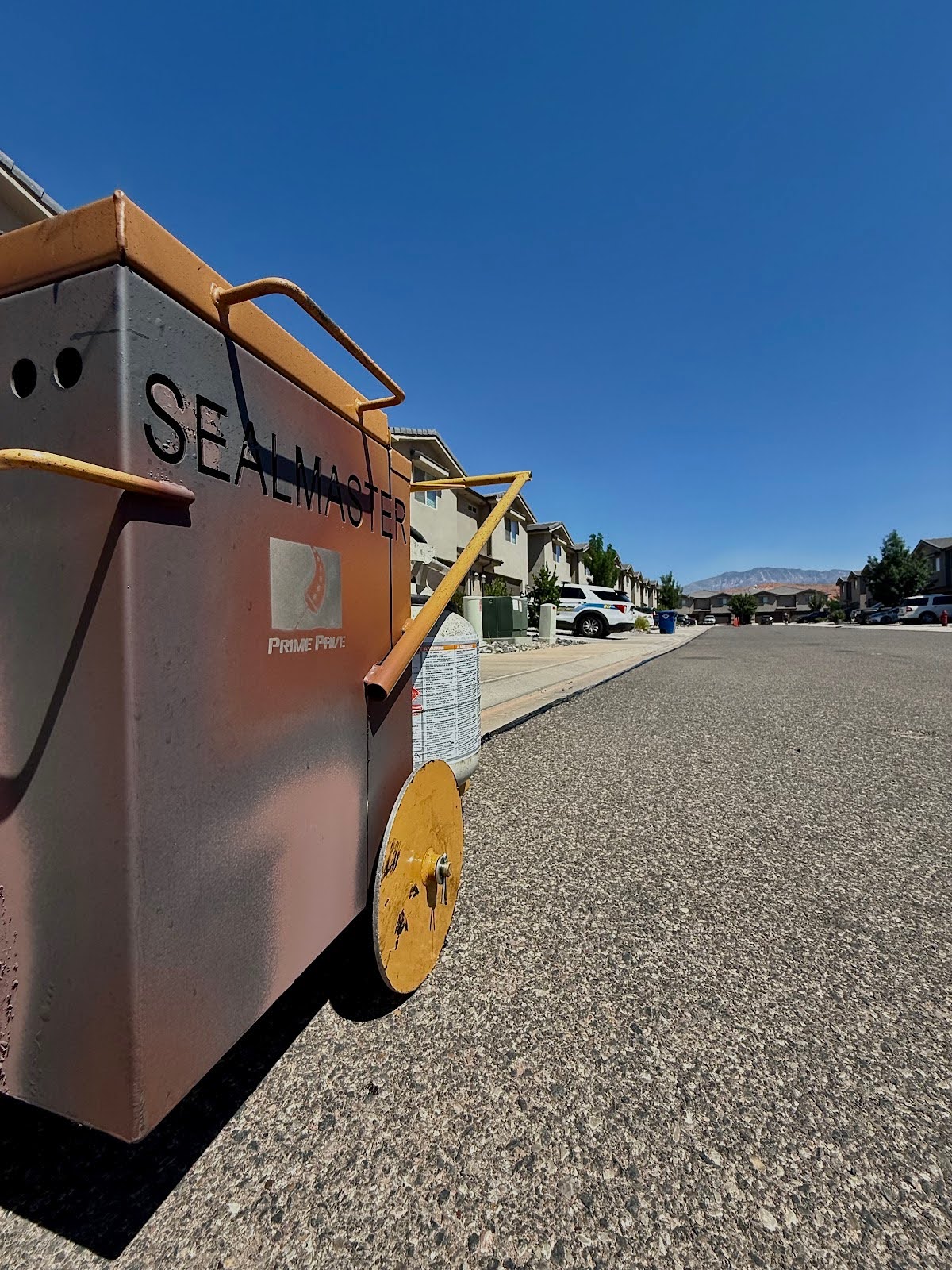
Choosing Prime Pave for your crackfilling needs ensures your pavement receives specialized protection engineered specifically for Southern Utah’s demanding desert climate. Beyond applying high-performance, hot-rubberized elastic sealers that flex through intense thermal expansion and resist monsoon downpours, Prime Pave has invested heavily in a diverse fleet of specialized equipment designed to handle projects of every scale—from large municipal roadways and commercial lots to tight residential driveways. Their capabilities are so trusted throughout the region that local competitor contractors routinely rely on Prime Pave's machinery fleet to complete their own jobs properly. By pairing versatile, top-tier machinery with an experienced crew that seals both active fractures and critical perimeter joints, Prime Pave effectively blocks non-compressible debris and floodwaters to maximize the structural lifespan of your asphalt.
Asphalt cracks should be inspected and filled annually, ideally in the late spring or autumn when temperature conditions are moderate. However, a general maintenance rule of thumb is to apply fresh elastic crack fill every 1 to 2 years, or as soon as new fractures wider than 1/4 inch appear. Addressing open cracks promptly prevents dirt, sand, and monsoon floodwaters from settling into the subbase, ensuring your pavement stays structurally protected between major sealcoating cycles.
Asphalt perimeter sealing is the process of applying a heavy-duty, rubberized joint sealer along the vulnerable edges where pavement meets concrete borders, such as curbs, gutters, sidewalks, and building foundations. In Southern Utah, intense thermal expansion causes asphalt and concrete to expand and contract at completely different rates, opening wide separation joints along the perimeter. Because asphalt and concrete are dissimilar materials, these perimeter joints are prime entry points for sand, dirt, and monsoon floodwaters. Non-compressible dirt settles into the gap, preventing the asphalt from expanding naturally in the summer heat and causing the edges to crush, break, and fracture further. Meanwhile, water penetrating the perimeter joint quickly undermines the adjacent subbase, leading to edge failure, severe alligator cracking, and sunken pavement. Although most contractors skip this critical step to save time and material costs, applying a specialized elastic perimeter sealer creates a long-lasting, watertight bond that accommodates differential movement, protecting the most vulnerable edges of your investment.

Learn what to expect from asphalt crack filling and perimeter sealing in St. George, Utah.
Join our Newsletter — Get Updates, Offers and Invites.